THE NEW ALIGNMENT: INDUSTRIAL REAL ESTATE IN 2026
A Three-Part Series introducing Mr. Warehouse.
PART 1: Global Logic, Local Intelligence, and the AI Edge
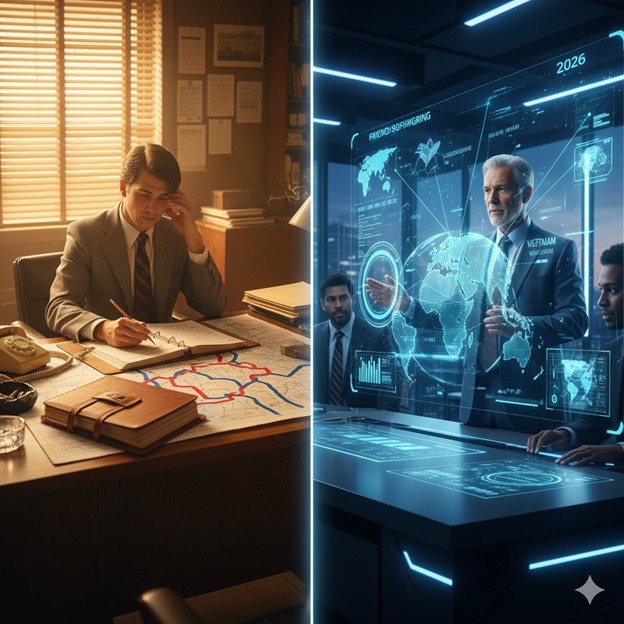
In my early days in the industrial real estate business, information was physical. Listings were delivered in three-hole-punched books, an inch thick, and we were “farm brokers” tethered to small, tightly drawn sub-markets in Los Angeles. If you stepped out of your boundary, you had to bring in a partner who worked that different turf. It was an era of high friction, but it birthed the deep local specialization and clients that stayed with me for decades.
Today, we are in a New Alignment. Two massive shifts are happening simultaneously: a geopolitical fracturing where U.S. bloc industries are “friend-shoring” away from traditional offshore centers, and a technological revolution where AI is partnering with humans to lead us to new directions. A major underpinning of the business, the agency relationship, will diminish as a transaction mindset takes hold. We are facing a reconfiguration of the industrial real estate business.
AI: The Lens for a Fractured World
The New Alignment allows us to have a global view that was previously impossible for a local broker. By mapping industrial infrastructure and supply chains within and across borders, we can see the “fracture” in real-time. Through our domestic and international network of SIOR brokers, we aren’t only looking at filling vacancies; we are examining how a specific property fits into a resilient global network. AI allows us to move beyond the “farm” mentality and into a high-level global network.
The Paradox: Better Global Tools, Better Local Intelligence
A side effect of this shift is that global tools and perspectives make us more aware of the local level. Even as we monitor global trade and production, these same techniques provide a sharper, more granular understanding of our home market. At Mr. Warehouse, we update our location mapping and pricing graphs for the Greater Los Angeles area monthly and offer these analytics to our partners in other markets. It’s a vast improvement from the days of weekly listing books.
AI opens new industrial real markets to explore. And by using what we learned locally, we can partner with our global colleagues to achieve what we couldn’t do alone.

PART 2: Industrial Infrastructure for the New Alignment
In the “farm broker” days, our data was fixed in a physical book. Today, our data lives with tools that capture intelligence. In the New Alignment, we don’t look only for real estate – although through that is the primary means we are compensated; we look for meaning in infrastructure, supply chain, humanity and how that fits into a model of production and distribution. We measure a central principle in the real estate business – location, location, location – and its impact on finance, operations, and the intangible.
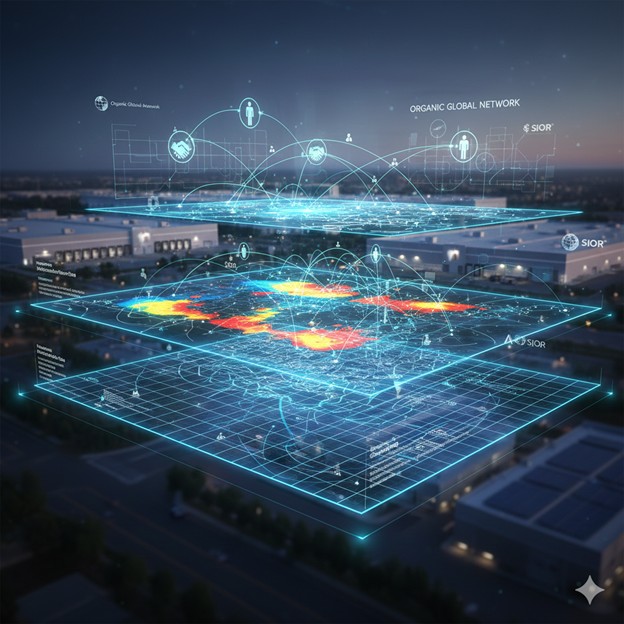
Mr. Warehouse adopts three layers of data. These tools allow us to map out the market with precision, helping occupiers and investors find the “nodes” that will thrive in a fractured economy.
Layer 1: The Infrastructure Map (Drupal & Parcel Data)
We use the Drupal Geofield module as a simple way to store and map industrial infrastructure location data. The map visualizes location and geographical relationships. By feeding high-resolution parcel-level, ownership and location into the map, we create a transaction platform not only around availabilities, but proximities.
Layer 2: The Logic of Localization (Streamlit & Analytics)
Once we create the physical map, we apply a layer of logic using Streamlit, an analysis software that uses a property database to calculate physical and value relationships for the purpose of making transactions. We turn raw data into meaning. For instance, our Los Angeles industrial data will show the closest and most optimum properties to move. For an occupier, this layer shows if a given site will optimize their supply chain or if they need to replicate their business, or a part of it, in a more efficient manner or hub.

Layer 3: The Organic Network (The Social Layer)
The most powerful data structure we have isn’t digital—it’s human. After 45 years in the business, with most of those years as an SIOR and attending over 65 conferences, our network of relationships is a living social map domestically and internationally. We use modern social networks and our Global SIOR partners to enhance our technology. It’s a privilege for me to work with the best in the business. This layer turns “data points” into “handshakes.”

PART 3: Proven Strategies, Intelligent Tools
In the industrial real estate business, the fundamentals haven’t changed in nearly half a century. Location is primary. Occupiers will always want to improve their business. Investors want a reasonable financial reward for taking on real estate risk. What is changing is how humans use machines and how artificial intelligence can serve, not as a tool, but a guide.
The Shift Toward Transactional Excellence
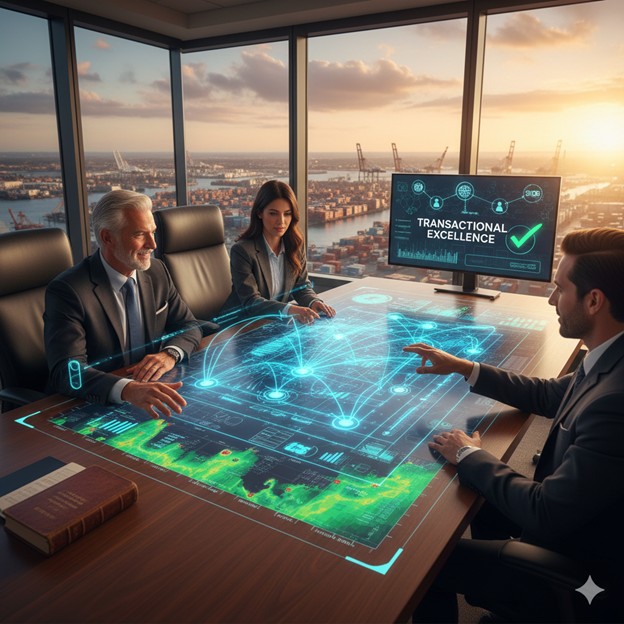
As we embrace the New Alignment, the nature of the relationship between broker and client is evolving. While State Real Estate Licensing Law emphasizes traditional agency relationships in their education and discipline, the reality for sophisticated corporations and institutional buyers is they want a transactional relationship. Clients want high-level intelligence, execution and data-informed results over traditional handholding. We always operate within agency law and focus on transactional success with the speed and precision.
The Human Partner in a Digital World
We are utilizing a sophisticated web-and-data stack to achieve these results:
- AI for Industrial Infrastructure and Supply Chain: We use AI to see the global “fracture” as it happens, predicting where the next major industrial nodes will grow.
- Parcel Mapping for Relationships: We use deep parcel data to build and maintain personal connections with owners and stakeholders.
- Global SIOR Collaboration: We collaborate on a personal and regular basis with SIOR colleagues located across the U.S. and the globe.
Conclusion: Understanding the New Alignment.
We use technology to understand location and network relationships under the New Alignment. While global in scope, the local becomes more informed. AI and Fragmentation will lead many of our client to succeed and we want to support them using new technologies and fundamental real estate principles. The New Alignment is a period of opportunity.